
Executive Summary
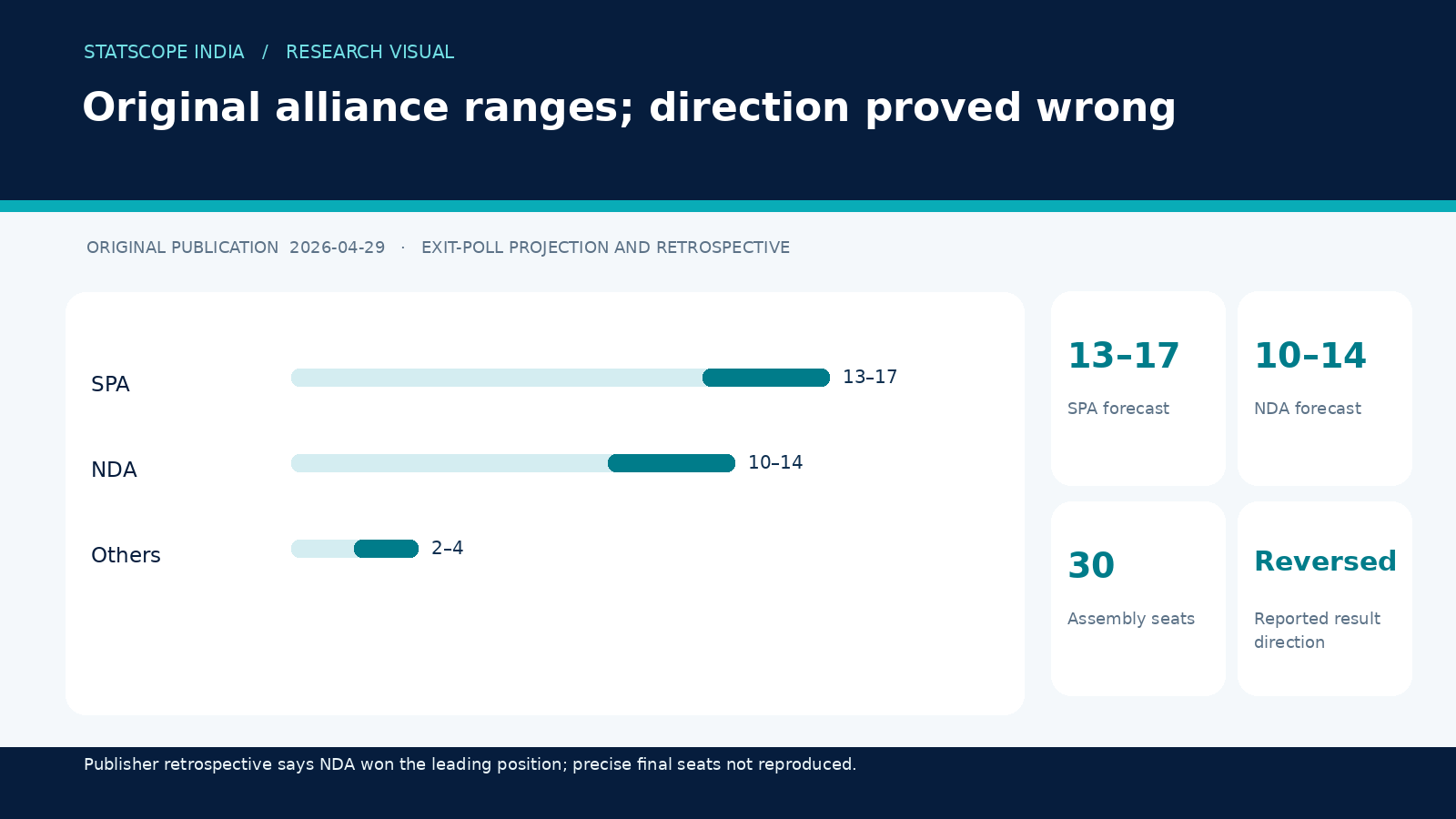
The 29 April 2026 Statscope India and Bharat Pulse News Puducherry exit poll suggested a close contest with the Secular Progressive Alliance (SPA) slightly ahead. It forecast 13–17 SPA seats, 10–14 NDA seats and two to four for others in the 30-member Assembly. The 6 May retrospective acknowledged that this directional call was wrong: the NDA-led formation performed better than the model anticipated, and the SPA failed to become the leading bloc.
Research Objectives & Scope
The research attempted to identify the likely largest grouping in a small and competitive Assembly, while accounting for new entrants TVK and NMK. The original article also provided party-wise ranges including Congress seven to nine, DMK six to eight, AINRC seven to nine and BJP one to three. Those ranges expressed forecast uncertainty and cannot be treated as compatible upper bounds that sum to a single result.
Key Findings
The original base scenario cited in the later review gave SPA 15 seats and NDA 12, consistent with an SPA advantage. Its published range nevertheless allowed substantial overlap. The retrospective described a result favouring the NDA and acknowledged that the pre-count conclusion had failed. Since the reviewed BPN retrospective did not set out a complete verified alliance seat table, this article does not invent an exact final NDA or SPA tally.
Research Approach
The 6 May review explains that the model had relied on 2024 parliamentary assembly-segment patterns, the 2021 Assembly election, ground-survey feedback and expected TVK/NMK effects. It argued that parliamentary preferences were over-weighted relative to local candidate relationships and the different logic of an Assembly contest. These are source-attributed modelling interpretations rather than independent causal proof.
Analysis & Implications
Puducherry illustrates how a small number of close constituencies can reverse a forecast about the leading formation. It also highlights a measurement challenge: dissatisfaction with an incumbent does not necessarily translate into a vote for a particular rival, particularly when candidate familiarity and local networks carry weight. Third-party vote splits may help or hurt different contenders across seats, making broad alliance calculations unreliable without a detailed local model.
Outcome & Retrospective
Retrospective published 6 May 2026: BPN stated that the final outcome contradicted the SPA-ahead call and identified five weaknesses, including reliance on parliamentary trends, local candidate effects, TVK/NMK impacts, turnout interpretation and alliance transfer. These remain the original analysts’ post-result diagnoses.
Limitations & Interpretation
The BPN material supplies forecast ranges and the qualitative direction of the error but not an independently checked final alliance seat table. The graphic therefore illustrates forecast ranges and clearly marks the directional miss without manufacturing an exact outcome figure.