
Executive Summary
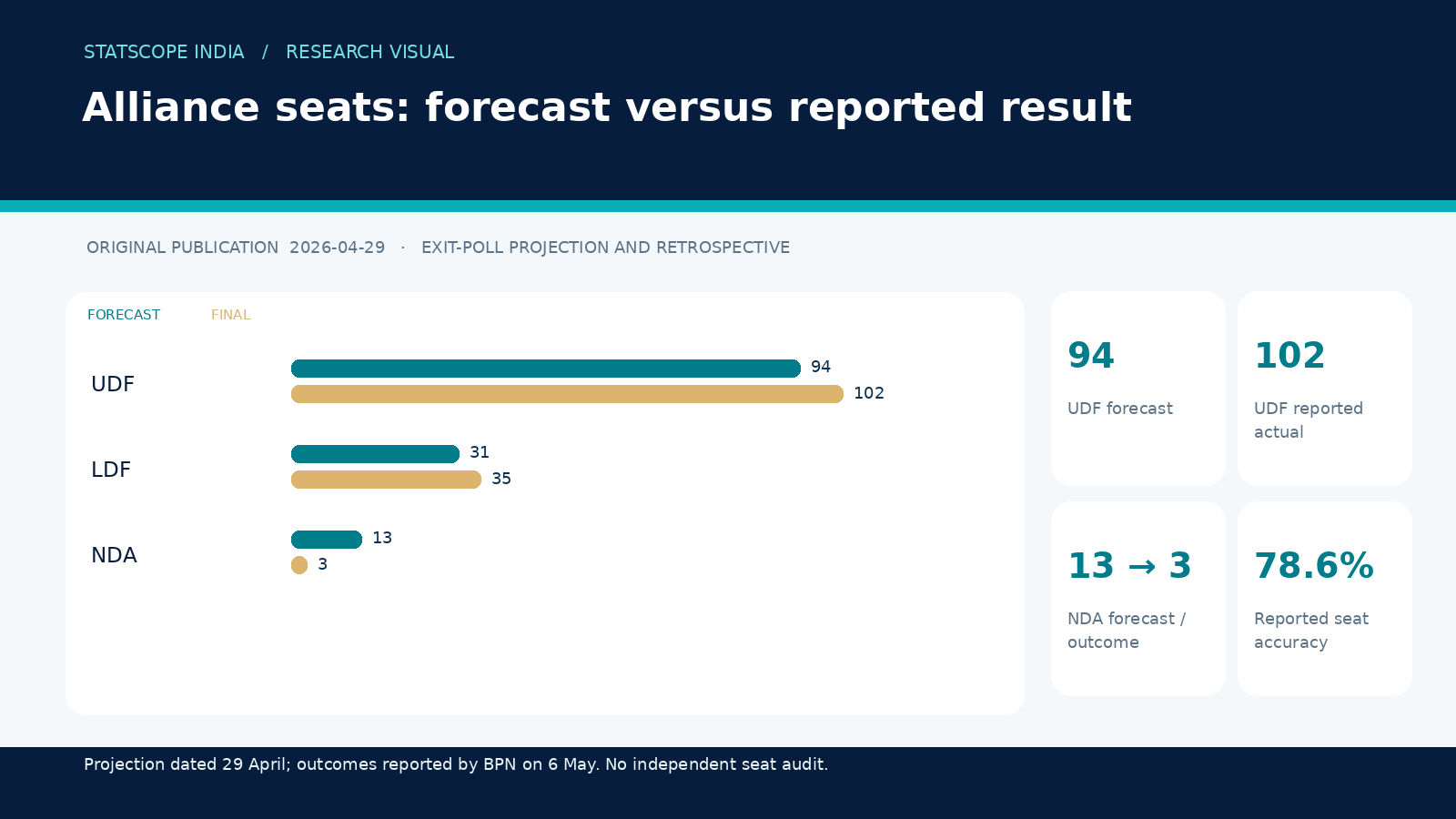
The Statscope India–Bharat Pulse News Kerala forecast, published on 29 April 2026, placed the United Democratic Front at 94 seats, well above the 71-seat majority requirement. The same forecast assigned 31 to the Left Democratic Front, 13 to the NDA and two to others. On 6 May, BPN published a retrospective reporting a UDF result of 102 seats, LDF 35 and NDA three, along with a claimed 110 correct constituency calls out of 140.
Research Objectives & Scope
This study focused on the competitive positions of Kerala’s main alliances and the likelihood that voter preferences could translate into a change of government. The original report supplied alliance-level seat forecasts and party-level ranges. The later assessment evaluated both the overall direction and the ability of the model to anticipate constituency winners.
Key Findings
The original estimate of 94 UDF seats was eight below the publisher-reported final 102. LDF was projected at 31 against a reported outcome of 35. The most notable seat-conversion error involved the NDA: 13 projected compared with three reported. BPN additionally claimed a constituency-level hit rate of 110 out of 140, or 78.6%. The forecast and the later figures are visually separated in the infographic to preserve their chronology.
Research Approach
BPN’s retrospective describes a layered modelling approach involving field feedback, electoral history, alliance factors and constituency conditions. However, its public version does not provide sufficient respondent-level details, sampling design or full constituency worksheets for an independently reproducible statistical audit. The percentages in this report are not presented as a national opinion measurement.
Analysis & Implications
The model’s UDF-ahead direction was borne out in BPN’s stated result comparison. Yet forecasting the governing alliance is not the same as accurately translating support for all parties into seats. The NDA overestimate illustrates that increased support or a strong presence in triangular contests does not necessarily produce a comparable number of elected members.
Outcome & Retrospective
Retrospective published 6 May 2026: BPN reported 102 UDF, 35 LDF and three NDA seats and assessed 110 of 140 constituency winners as correctly predicted. It attributed part of the NDA discrepancy to tactical voter consolidation, an interpretation recorded here as an explanation proposed by the original analysts rather than a separately tested causal result.
Limitations & Interpretation
The result figures and 78.6% strike rate reproduce BPN’s post-election review and have not been independently re-audited at constituency level. Original-poll and later-result figures must remain labelled separately in the final website.