Executive Summary
The 18 January 2026 Statscope India contribution argued that an EV transition should be judged by its ability to reduce petrol and diesel consumption, not merely by the number of electric vehicles sold. It also pointed to charging patterns and local distribution capacity as key practical constraints. The article advanced a policy framework; its proposals were not presented as regulations already enacted nationwide.
Research Objectives & Scope
The study focused on high-volume road-transport fuel users, urban charging demand, residential permissions, time-dependent electricity pricing and distribution-system readiness. It proposed a phased regulatory approach linking adoption targets with measurable oil displacement and manageable grid demand.
Key Findings
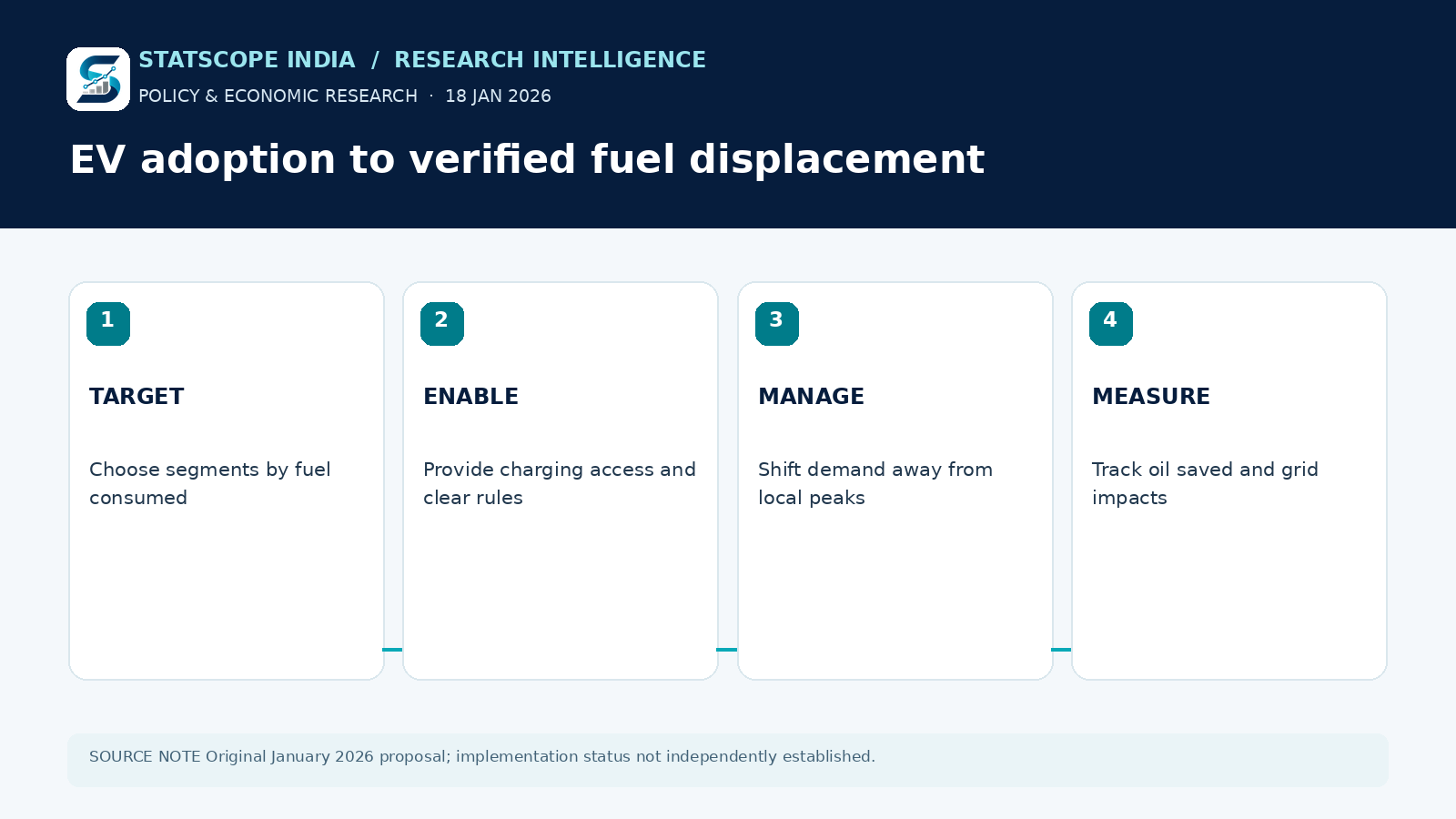
The article prioritised two-wheelers, urban passenger vehicles and commercial fleets as feasible near-term segments. Its implementation pillars included smart charging, time-of-use signals, clear apartment-level permissions, distribution planning and outcome-based assessment. It warned that unmanaged evening charging could create avoidable local peaks even if national electricity supply increased.
Research Approach
The paper combined an energy-demand scenario with a diagnosis of administrative and consumer barriers. Fuel and generation estimates in the original article depend on selected assumptions and should not be used as current operating statistics without updated official data.
Analysis & Implications
The distinction between energy adequacy and distribution readiness is important: enough annual electricity does not guarantee that a neighbourhood transformer can safely handle coincident charging at peak hours. Measurable outcomes would therefore include litres of fuel avoided, average charging time, local peak impact and customer access to reliable infrastructure.
Outcome & Retrospective
This archive preserves the January 2026 recommendations as a policy proposal. A later implementation audit would need to check which rules had been adopted by state authorities and distribution companies.
Limitations & Interpretation
The infographic is a proposed implementation chain. It does not claim that the measures were formally enforced or that oil-displacement targets were achieved.