
Executive Summary
The 1 September 2025 BPN article incorporated Statscope India partners’ analysis of India’s move towards petrol blended with 20% ethanol. It compared that transition with Brazil’s longer experience and argued that motorists need clearer compatibility information and pricing transparency. The publication was a policy critique, not a new representative survey of vehicle owners.
Research Objectives & Scope
The analysis examined the relationship between ethanol blend levels, older vehicle fleets, engine material compatibility, fuel efficiency and choices at the pump. It also considered potential distributional effects on drivers using vehicles made under earlier fuel specifications.
Key Findings
The authors distinguished older E10-era vehicles, later vehicles described as E20 material-compatible and newer vehicles designed specifically for E20 operation. They argued that different forms of compatibility should not be presented as identical. The article questioned whether blending-related savings and costs were adequately visible to consumers, and called for a more clearly staged transition.
Research Approach
The publication drew on policy comparisons, automotive standards and technical commentary. It did not present independent engine-durability trials, a verified national mileage test or a measured consumer sample. Vehicle-specific advice should be checked against the relevant manufacturer rather than inferred from a single model-year grouping.
Analysis & Implications
Energy security, agricultural feedstock demand and consumer cost are connected but distinct policy objectives. A transparent transition should make fuel specifications intelligible, establish accessible compatibility information and examine whether pump-price signals reflect differences in blend composition. Without credible communication, uncertainty can undermine public confidence even where a policy has strategic merits.
Outcome & Retrospective
This article records Statscope-associated concerns and proposals as expressed in September 2025. It should not be treated as up-to-date technical instructions for individual vehicles.
Limitations & Interpretation
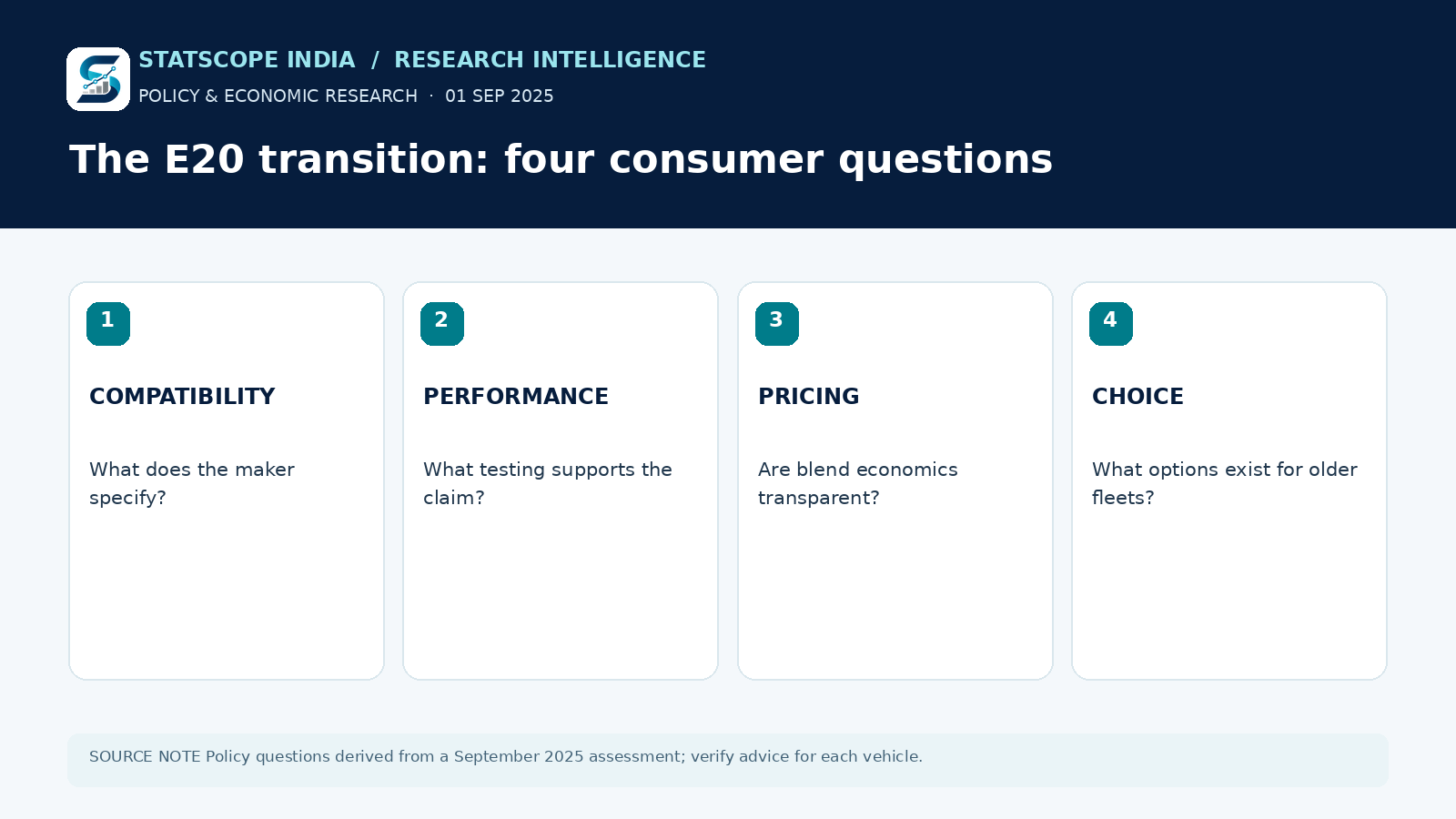
The infographic maps the policy decision process, not the compatibility of any specific car or motorcycle. No quantified mileage loss or nationwide consumer response is claimed.