
Executive Summary
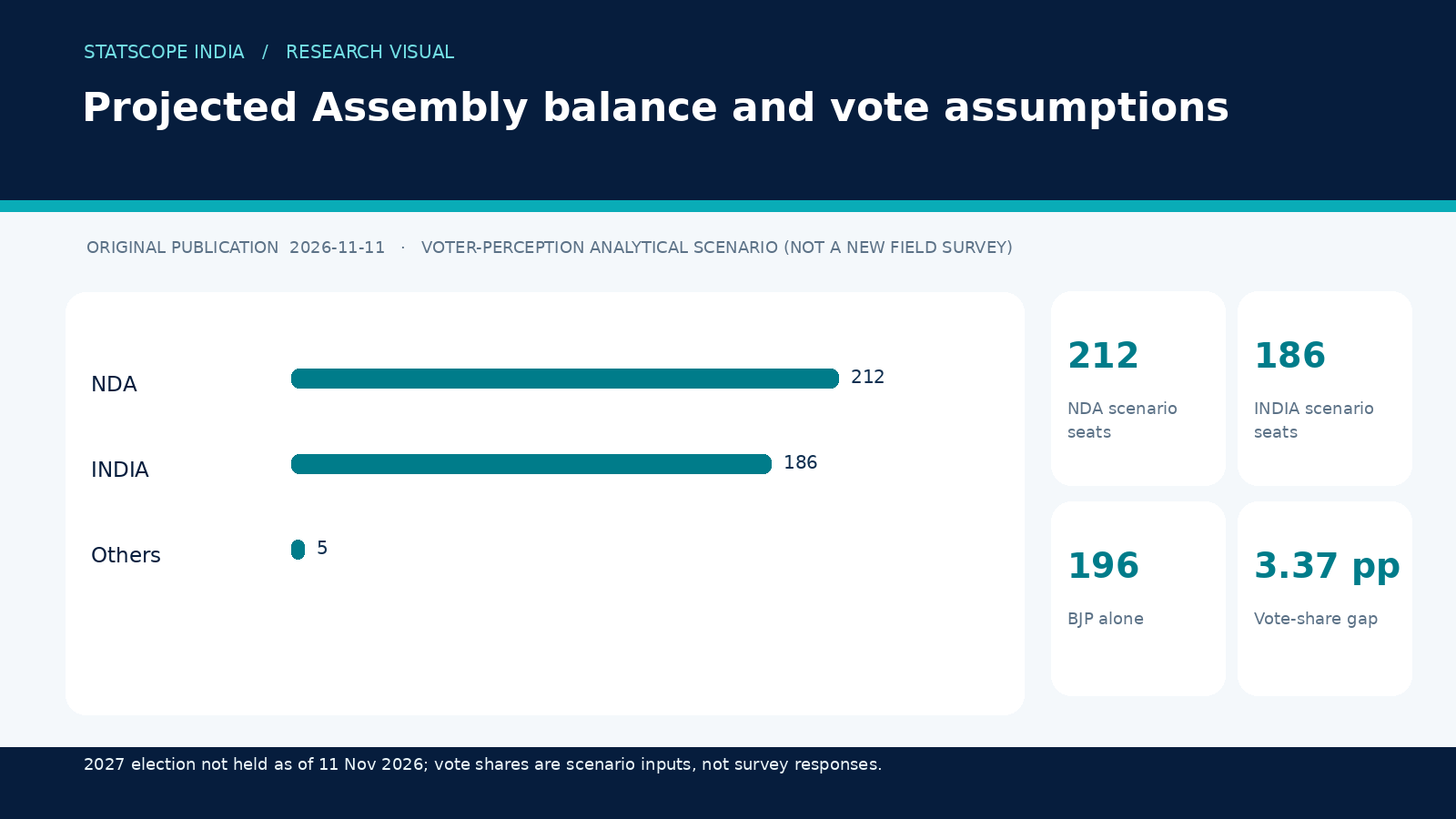
Statscope India and Bharat Pulse News published a forward-looking Uttar Pradesh electoral assessment on 11 November 2026. The scenario placed the NDA at 212 of 403 seats, the SP-Congress-led INDIA grouping at 186 and others at five. It separately positioned the BJP at 196 seats, below the 202-seat majority threshold, making the difference between an alliance majority and a party majority the central finding.
Research Objectives & Scope
The assessment considered political-party perception and leadership preferences following the 2024 Lok Sabha election and subsequent by-elections. Its focus was the competitive balance between the formations associated with Yogi Adityanath and Akhilesh Yadav, the likely shape of the next Assembly under the stated scenario, and the degree to which coalition partners could matter. It did not claim to model every individual candidate’s local accountability or personal appeal.
Key Findings
The joint projection assigns 212 seats to the NDA, 186 to INDIA and five to others. Within the NDA it gives BJP 196, RLD nine, Apna Dal (Sonelal) six and SBSP one. Within INDIA it gives SP 149, Congress 36 and Trinamool Congress one. Its statewide vote-share assumptions are 45.29% for the NDA, 41.92% for INDIA and 12.79% for others, leaving a gap of 3.37 percentage points between the two main groupings.
Research Approach
The November publication describes an analytical voter-preference scenario based on party perception and chief-ministerial leadership preferences. It explicitly states that the vote-share inputs should not be misrepresented as a newly and separately conducted field survey. The archive likewise does not invent respondents, sample size or a conventional survey margin of error.
Analysis & Implications
The most politically consequential distinction lies within the governing alliance. The NDA clears the majority mark by ten seats under the scenario, but the BJP falls six seats short on its own. The allies’ combined 16 seats therefore become necessary to reach the modelled 212. On the opposition side, a projected 186-seat bloc would retain significant legislative strength and remain close enough for constituency changes to matter.
Outcome & Retrospective
As of the original 11 November 2026 publication, the 2027 Assembly election had not taken place. This page is a forecast scenario, not a retrospective or an observed election result. Its numbers should remain linked to the date on which the assessment was issued and should be reviewed only through clearly dated later updates.
Limitations & Interpretation
The projection does not account for every candidate, last-minute campaign development or alliance realignment. The percentages are modelling assumptions, not election results and not approval ratings. A precise interpretation of any future change requires a newer dated assessment rather than treating the 2026 scenario as live polling.