
Executive Summary
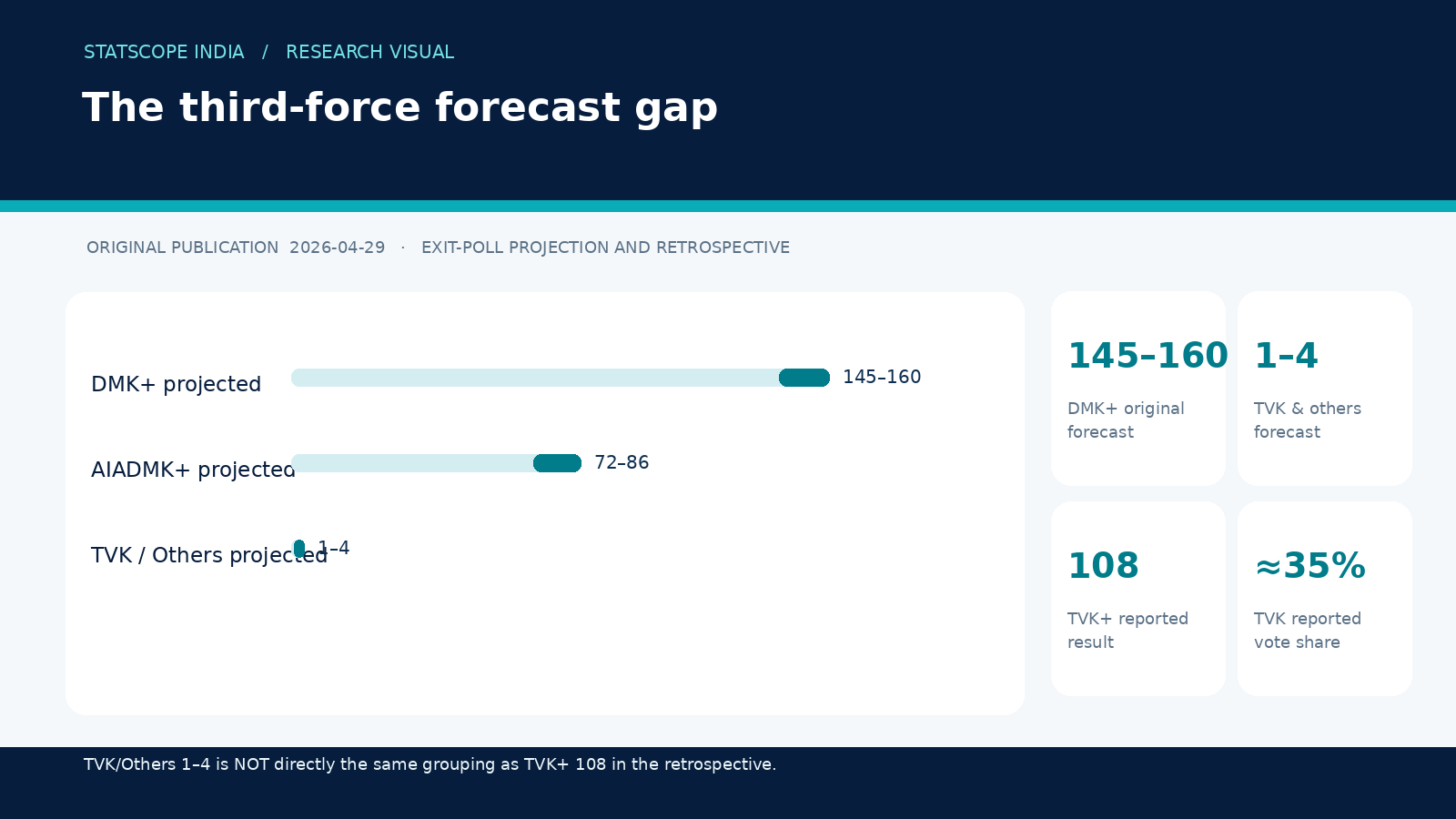
Statscope India and Bharat Pulse News’s 29 April 2026 Tamil Nadu projection put the DMK-led alliance at 145–160 seats and AIADMK+ at 72–86, with only one to four seats allocated to TVK and other smaller players combined. The subsequent result, as described in BPN’s 6 May retrospective, was profoundly different. The review reported TVK+ winning 108 seats with nearly 35% of the vote, and explicitly acknowledged that the original forecast was wrong.
Research Objectives & Scope
The initial model examined alliance advantages, constituency patterns and the effect that a new political force could have in triangular contests. Its central premise was that the newcomer might disrupt margins without winning many constituencies. The retrospective reassessed that assumption after the electoral outcome demonstrated much stronger conversion of TVK support into seats.
Key Findings
Three forecast bands defined the original call: DMK+ 145–160; AIADMK+ 72–86; TVK and others combined one to four. The 6 May review reported that internal field-level work had detected roughly 25% support for TVK across surveyed constituencies but that a working statewide correction still treated it at around 24–25%. The same review placed the eventual TVK vote near 35% and cited a TVK+ tally of 108 seats. Those figures came from different grouping definitions and stages of analysis, so they should not be presented as directly equivalent series without their labels.
Research Approach
The public retrospective describes field observations alongside a seat-conversion model incorporating electoral history, alliance transfer, candidate positioning and assumptions about three-cornered contests. The original source does not provide a respondent-level dataset allowing the underlying vote estimate, timing or seat calculations to be independently reproduced.
Analysis & Implications
The decisive error was underestimating the potential for a growing third force to become a principal challenger rather than merely redistribute support between established blocs. The review suggested that late consolidation and the translation of scattered opinion into winnable constituencies were misread. That explanation is a post-result interpretation from the original authors and should not be mistaken for evidence from a controlled study.
Outcome & Retrospective
Retrospective published 6 May 2026: the partnership openly withdrew the directional implication of its DMK+ forecast and accepted the model’s failure. It argued for stronger treatment of late campaign changes and for revisiting how emergent parties are modelled in first-past-the-post contests. The historical 29 April seat ranges remain on the page without post-hoc revision.
Limitations & Interpretation
The later reported 108-seat figure refers to TVK+ while the earlier one-to-four forecast grouped TVK with others. Those categories are not strictly comparable. Vote-share values attributed to the review are internal estimates and later publisher-reported outcomes rather than independently audited figures in this archive package.