
Executive Summary
Statscope India’s cinema-going survey, cited in a Bharat Pulse News article dated 19 August 2026, identified high mall parking charges as one of the factors discouraging some respondents from visiting multiplexes more often. The associated analysis argued that moviegoers judge affordability by the whole outing, not the ticket alone. The publicly available report does not disclose a nationally representative sample or a precise percentage citing parking.
Research Objectives & Scope
The research concerned how consumers perceive the cost and convenience of an in-person movie experience. It placed parking beside tickets, optional food, online booking charges, travel and the alternative of streaming at home. The report’s emphasis was on purchase experience and perceived value rather than solely on cinema operator revenue metrics.
Key Findings
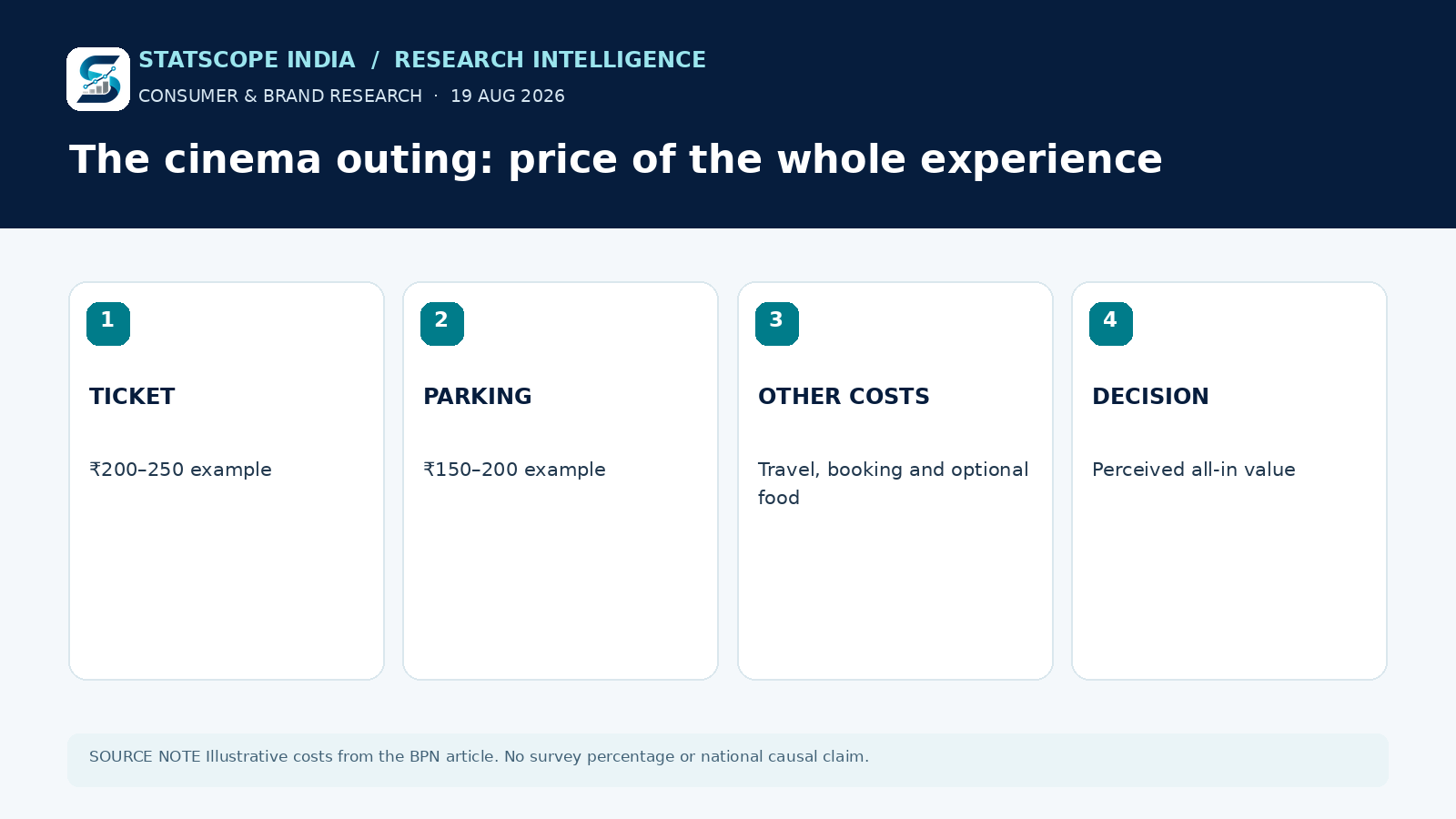
Respondents reportedly identified expensive parking as an important deterrent to more frequent visits. The publication used illustrative combinations such as a ₹200–₹250 ticket and a ₹150–₹200 parking charge to show how ancillary costs can approach the price of admission itself. Those examples are cost scenarios, not a measurement of every cinema’s charges.
Research Approach
The article reports the direction of a Statscope survey finding but does not reproduce respondent counts, geography, demographic composition, questionnaire wording or weighting. It therefore cannot support a claim that any specified percentage of Indians share the view or that parking changes alone caused nationwide attendance declines.
Analysis & Implications
Multiplex chains frequently track average ticket price and food-and-beverage revenue per head. Consumer research should also track total discretionary expenditure, the convenience of reaching a venue and the friction associated with parking or booking. This distinction can help operators test bundled parking offers, location-specific promotions and clearer all-in pricing.
Outcome & Retrospective
This is a record of the August 2026 perception finding. It does not imply that operators adopted the suggestions or that any subsequent attendance increase was caused by parking policy.
Limitations & Interpretation
The infographic uses a clearly labelled illustrative trip-cost example, with no fabricated survey response percentages.