
Executive Summary
The 27 September 2025 research argued that Rajasthan and Gujarat could use land and high solar-resource potential to reduce exposure to imported gas in electricity generation. It contrasted the recurring expense of burning LNG with the multi-decade output of solar assets. Its figures were illustrative investment scenarios, not evidence that a complete gas-for-solar replacement had already occurred.
Research Objectives & Scope
The article compared imported LNG expenditure, generation cost assumptions, photovoltaic capital investment and land requirements. It considered whether states with established solar projects could expand installed capacity while improving long-run energy security.
Key Findings
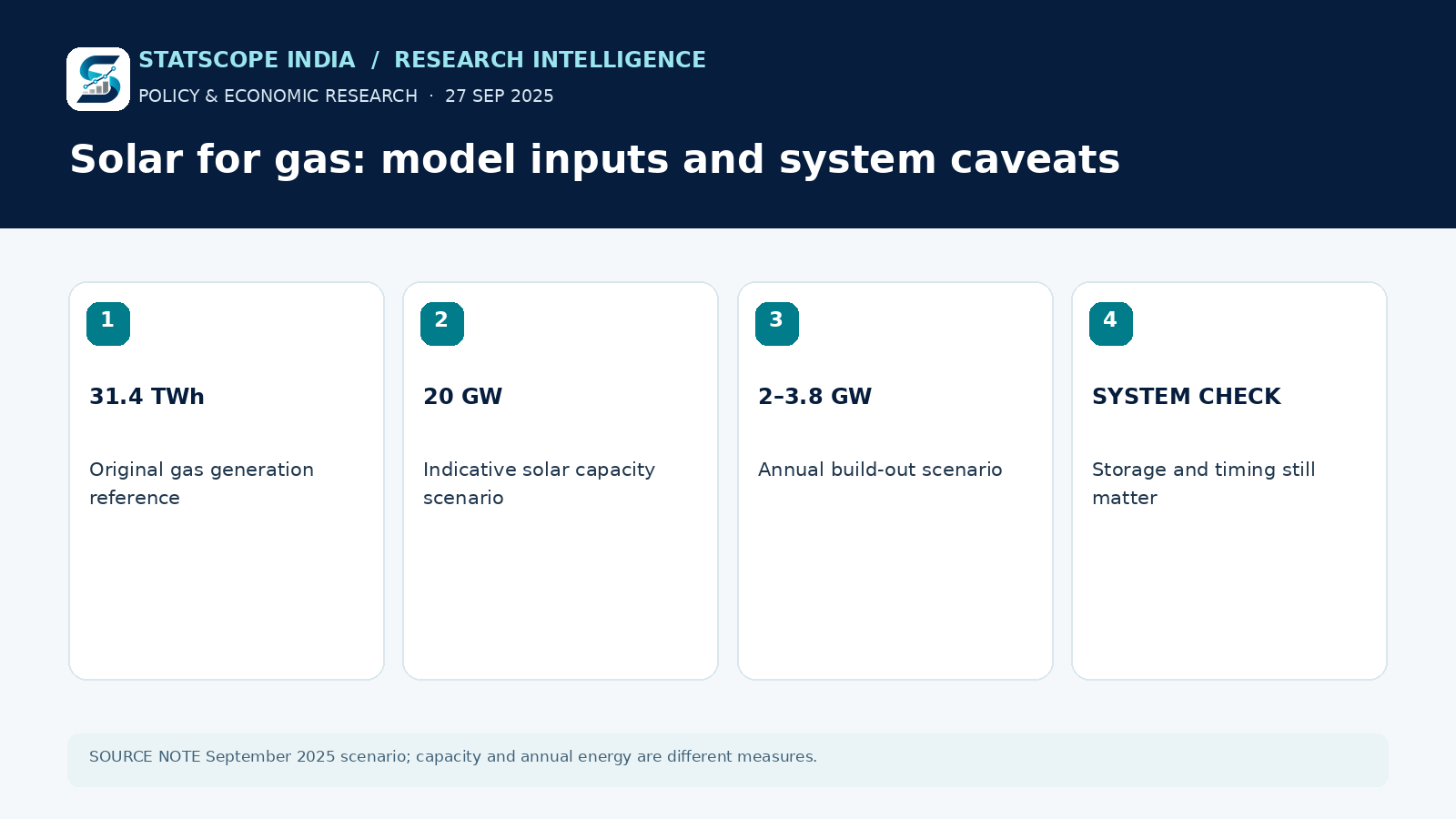
The publication referred to about 31.4 TWh of gas-fired generation and modelled a replacement scenario involving around 20 GW of solar capacity. It estimated that investment comparable to US$1.0–1.6 billion in annual LNG spending might support 2–3.8 GW of new solar projects each year under the cost assumptions then used. These figures are not interchangeable: installed gigawatts and annual generated terawatt-hours describe different quantities.
Research Approach
The study drew on assumed costs per unit of electricity, project capital expenditure and land requirements. It is best treated as a first-pass scenario comparison. A dispatchable gas plant and variable solar generation differ in their timing and system roles; a full system model would need storage, transmission and backup capacity.
Analysis & Implications
The strongest policy insight is the trade-off between recurring fuel purchases and investment in durable domestic infrastructure. An energy-security strategy should also value flexibility during evening peaks, seasonal variation and grid constraints. Capacity replacement cannot be assessed solely through annual energy volume.
Outcome & Retrospective
The page preserves a September 2025 proposal for consideration. It does not imply that the projected capacity, jobs or avoided imports were subsequently realised.
Limitations & Interpretation
All construction, saving and land estimates are conditional on original assumptions and subject to changing technology and fuel markets. The infographic compares study inputs only.