
Executive Summary
The original analysis published on 15 August 2025 examined proposed GST reductions before their practical implementation. It modelled how lower tax rates might translate into retail-price reductions and subsequent consumer demand, distinguishing ordinary household goods from higher-tax durables. Crucially, the article was a forward-looking scenario, not a measurement of prices that had already fallen.
Research Objectives & Scope
The study focused on a hypothetical shift of goods from 12% GST to 5% and certain goods from 28% to 18%. It asked what a full pass-through would imply for consumer prices and how price-sensitive categories might respond. It also addressed the difference between unit-sales growth and company revenue.
Key Findings
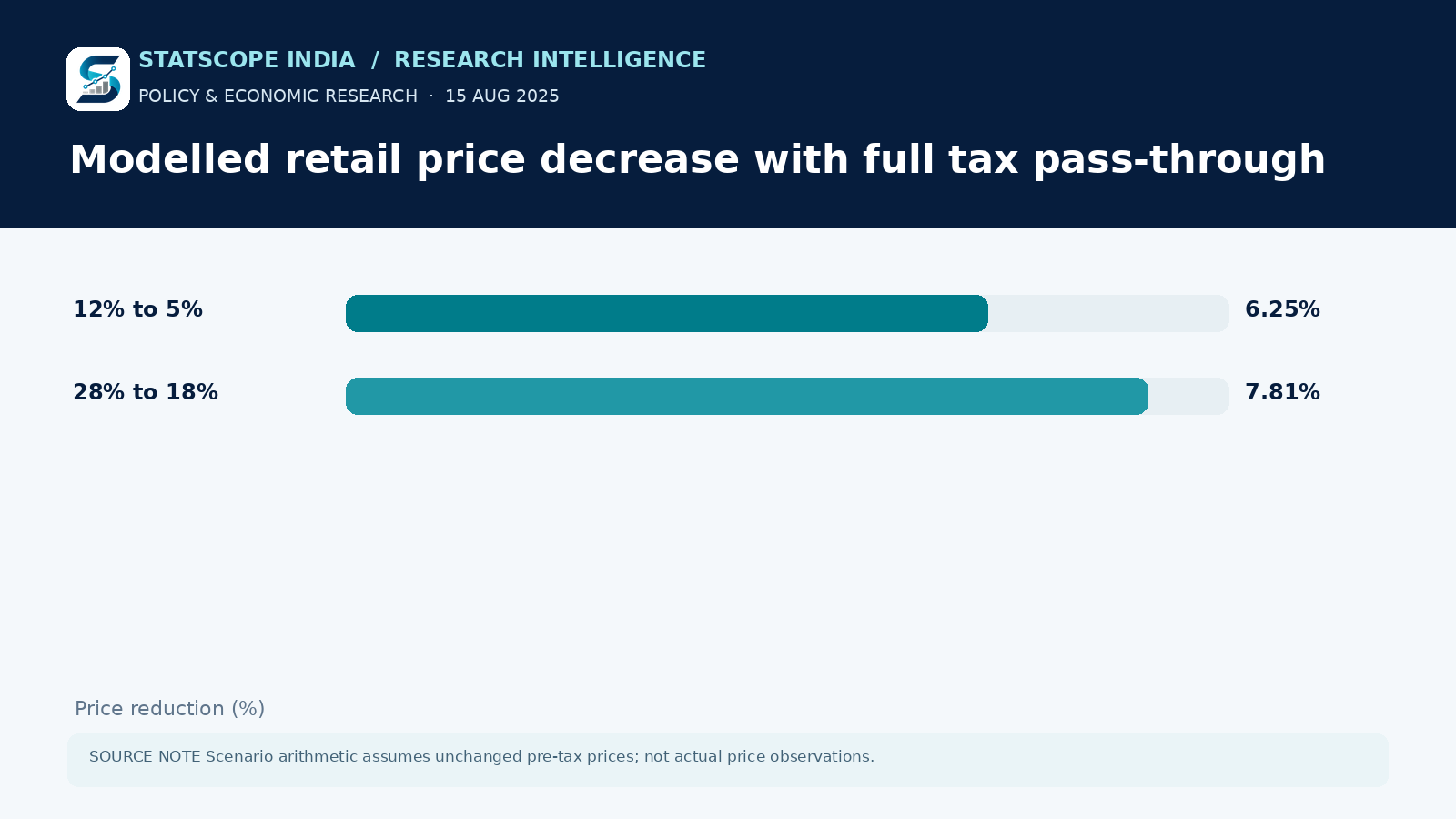
For a product whose pre-tax price is unchanged, reducing a 12% GST rate to 5% implies a final-price reduction of 6.25%. Reducing 28% to 18% implies a 7.81% reduction. The original analysis used these relationships to construct examples for food products, air-conditioners, dishwashers, cement and vehicles. Elasticity assumptions produced different projected volume effects by category.
Research Approach
The calculations applied tax-inclusive price arithmetic and elasticity-style demand scenarios. They depended on unchanged pre-tax prices, correct classification and consumers receiving the full rate cut. The published scenarios did not constitute a randomised study of actual purchasing behaviour.
Analysis & Implications
A tax-rate announcement is only the first step in a consumer price chain. Manufacturers may adjust base prices, promotions, pack sizes or distribution margins, and demand can depend on income, financing and expectations. A stronger post-implementation evaluation would track matched SKUs, printed prices and transaction values over time.
Outcome & Retrospective
This report retains its 15 August 2025 pre-implementation status. Related follow-ups were published on 4 September and 23 October 2025 and should be linked as distinct pieces in the research archive.
Limitations & Interpretation
The percentage reductions are mechanical full-pass-through scenarios, not observed price changes. Product-specific eligibility may differ from assumptions discussed before final rules.