
Executive Summary
A joint research publication on 30 May 2025 examined whether agricultural carbon credits could contribute to farmer income while supporting lower-emission practices. It linked soil-carbon and residue-management techniques with voluntary credit markets, certification and payments. The headline revenue scenarios are useful for understanding the potential, but do not represent actual or guaranteed earnings for Indian farmers.
Research Objectives & Scope
The article analysed soil-carbon sequestration, carbon-credit pricing, crop-specific earning possibilities and the practical challenges of enrolling small farms. It also explored whether verified payments could encourage alternatives to crop-residue burning in northern India.
Key Findings
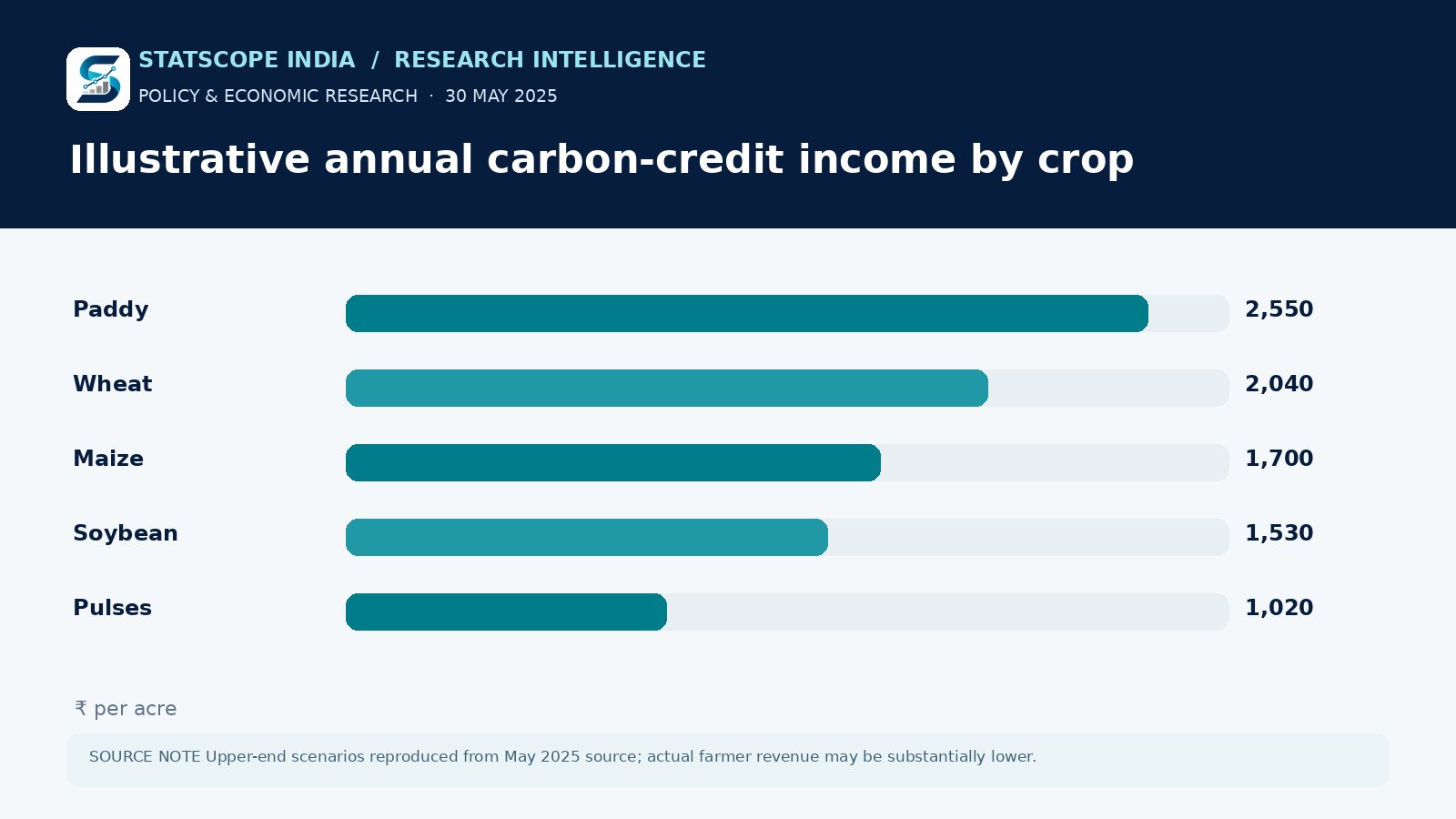
The original publication estimated sequestration of 0.5–1.5 tonnes of CO₂-equivalent per acre annually and an indicative soil-credit price of ₹670–₹1,700 per tonne. Multiplying the assumptions produced a broad gross potential of roughly ₹335–₹2,550 per acre per year. Crop-specific scenarios varied. Actual receipts would be affected by measurement, aggregation, monitoring, verification and other fees.
Research Approach
The source assembled scenario inputs from agricultural carbon-project providers and market ranges. This is a modelling exercise and sector review. It is not a verified yield trial across Indian farms or a nationwide opinion survey. Carbon accounting must also address additionality, permanence and the risk that the same benefit is counted more than once.
Analysis & Implications
The commercial question is not merely whether carbon can be sequestered. It is whether farmers receive a transparent share of revenue after project costs, and whether monitoring costs are low enough for small holdings. Producer organisations and digital payment records could help reduce information asymmetry. A farmer-facing disclosure of contract duration, credit ownership and fees is as important as the gross price headline.
Outcome & Retrospective
This archive entry retains the estimates as proposed in May 2025. It does not imply that the stated range is available on every crop, farm or registered project today.
Limitations & Interpretation
All amounts in the infographic are illustrative original-study scenarios before relevant deductions. The graphic is not financial advice or an offer to purchase carbon credits.