
Executive Summary
The 29 May 2025 BPN–Statscope analysis examined how Indian states responded to trade disruptions surrounding the US–China tariff conflict. Rather than treating India as a single export platform, it compared four state-level industrial ecosystems: Gujarat, Maharashtra, Tamil Nadu and Uttar Pradesh. The central proposition was that infrastructure, supplier networks and local policy execution shape how quickly regions can take advantage of changing overseas demand.
Research Objectives & Scope
The research sought to identify which capabilities mattered in the trade response and why the opportunities might not be shared equally across states. It considered ports, manufacturing clusters, engineering and pharmaceuticals, electronics, agricultural processing and district-level export promotion.
Key Findings
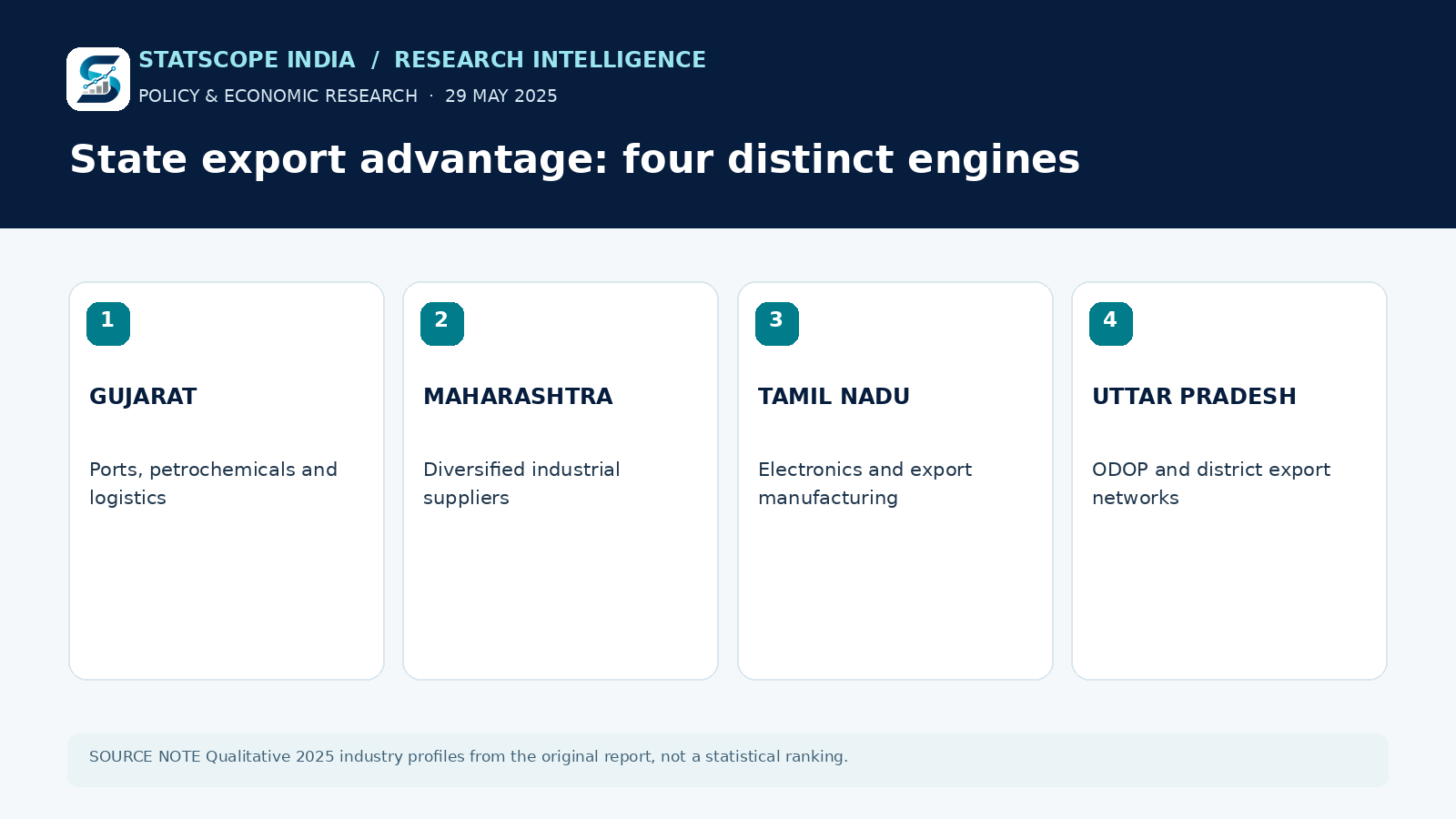
The original report highlighted Gujarat’s ports and commodity export infrastructure, Maharashtra’s broad industrial ecosystem, Tamil Nadu’s electronics and export-manufacturing expansion, and Uttar Pradesh’s district-based export initiatives. Its source article cited Gujarat contributing more than one-third of India’s exports and described a sharp year-on-year rise in iPhone exports associated with Tamil Nadu. These are dated historical observations, not current shares.
Research Approach
The publication combined public economic indicators with corporate and state-level examples from early 2025. It was a comparative narrative assessment rather than a statistical survey of exporting firms. State-level totals can be sensitive to shipment ports, ownership of production and the period used in reported data.
Analysis & Implications
The analysis suggests a useful framework for measuring subnational readiness: logistics access, sector diversity, skilled supply chains, local policy response and export-market concentration. The next step for a robust quantitative research series would be to normalise these indicators across comparable periods and distinguish trade rerouting from genuinely new domestic value addition.
Outcome & Retrospective
This page documents the assessment available in May 2025. It does not use later trade statistics to rewrite the original state comparison or claim that tariffs alone caused every observed export gain.
Limitations & Interpretation
The four-state graphic is a qualitative capability map. It is not a ranked index and does not imply that the states were directly comparable using one verified score.